

nature in learning
and therapy
A personal development programme for those who want to build a stronger connection with nature. The programme is open to anyone interested in nature, as well as professionals working with people who would like to learn how to consciously incorporate nature into their professional practice.
Who is the programme for?
For professionals working with people and for those looking for a new direction in their lives.
The programme is for professionals looking for new directions in their work and wanting to bring nature more consciously into their practice.
For education professionals: teachers, kindergarten teachers, trainers, speech therapists, special education teachers, youth workers, coaches, etc
.
For mental health professionals: psychologists, psychotherapists, occupational therapists, creative therapists, social pedagogues, child protection workers, peer counsellors, mental health nurses, doctors and others.
12 modules,
certificate
The programme consists of 92 academic hours of classroom-based learning and 25 hours of independent work.
At each meeting, we explore and experience a new topic, while the time between meetings is intended for practising and reflecting on what has been learned.
The programme is designed as one whole, with all modules connected to one another.
All modules include practical activities in nature or in the garden.
Upon completing the programme, participants receive a certificate. To receive the certificate, participants must attend at least 80% of the classroom-based learning, complete all independent assignments and submit the final project.
Where and
when?
Aegviidu and various natural environments.
Most of the programme takes place in the nature surrounding Aegviidu and at the KONTAKT LOODUSEGA studio. Depending on the topic, different modules may also take place in other environments.
Dates:
13.10 · 10.11 · 08.12 · 09.02 · 09.03 · 16.04 · 20.05–21.05 · 08.06 · 24.08 · 14.09
Group: maximum 10 participants.
The organiser reserves the right to change the order of the modules depending on the weather and season.
Purpose and payment
The aim of the programme is to inspire and encourage professionals to bring their work into nature, offer new directions for developing their professional practice, and support the prevention of burnout.
During the programme, participants gain the knowledge and skills needed to incorporate nature into their professional practice and strengthen their own connection with nature.
Price: special price €1,860 (until 20.09.26), thereafter €2,100
Payment can be made in four equal instalments (September, December, March, June).
A €50 registration fee is payable upon registration. The registration fee is non-refundable if you withdraw from the programme.

join the group
The group is currently full. Register your interest and I will send you information when we open a new group.
12 modules
The programme is structured so that each meeting focuses on a new topic.
The time between meetings is intended for practising and reflecting on what has been learned. The programme forms one whole, with all modules connected to one another.
All modules include practical activities in nature or in the garden.
100 academic hours and 30 hours of independent work.

Aim: Become more aware of your relationship with nature, awaken your senses and experience presence in nature.
Topics: Why do we need nature? The impact of nature on health. Forest bathing and forest therapy. Different approaches and terminology. Experiencing the effects of the forest.

Aim: Create new and deeper relationships with the world of plants.
Topics:
-
We become friends with one plant, exploring how to create personal and meaningful relationships with plants through memories, the senses, stories and co-creation. Practising this skill gives us an opportunity to expand our “circle of friends” and encounter familiar, cherished and supportive companions at home, in the city, in the countryside or abroad — and even in our imagination when we need support.
-
Hands-on activities with plants — gathering and working with different plant materials such as willow branches, spruce roots, cattail leaves, pine needles and sedges. Previous experience or the final result is not important in the creative process. What matters is the opportunity to connect directly with nature, express yourself creatively, explore different materials through touch, and experience the calming and absorbing effect of repetitive, rhythmic movements.
-

Experiential module for self-discovery — in the forest, by the sea, experiencing fire and snow.
Aim: Gain an overview of working in nature and experience exercises for self-discovery in different natural environments — forest, sea, fire and snow. Become more aware of your personal goals and needs.
Topics: Overview of the field and different approaches. Experiential metaphor exercises in nature.
NB! One module takes place in the forest, another by the sea, and a third in winter, with snow and fire.

Aim: Learn how to prepare for working in nature and choose a suitable environment.
Topics: Preparation and equipment. Clothing and what to bring. Choosing the environment. Limitations, risks and challenges. The impact of the seasons.

Aim: Understand how to structure nature-based activities and take the needs of different target groups into account.
Topics: Structuring work in nature. Different age groups. Family and group work. Choosing the environment according to the target group.

Aim: Become aware of ways to bring nature into indoor and work environments.
Topics: Nature at home and at work. The impact of our surroundings. Environmental analysis. Essential oils.
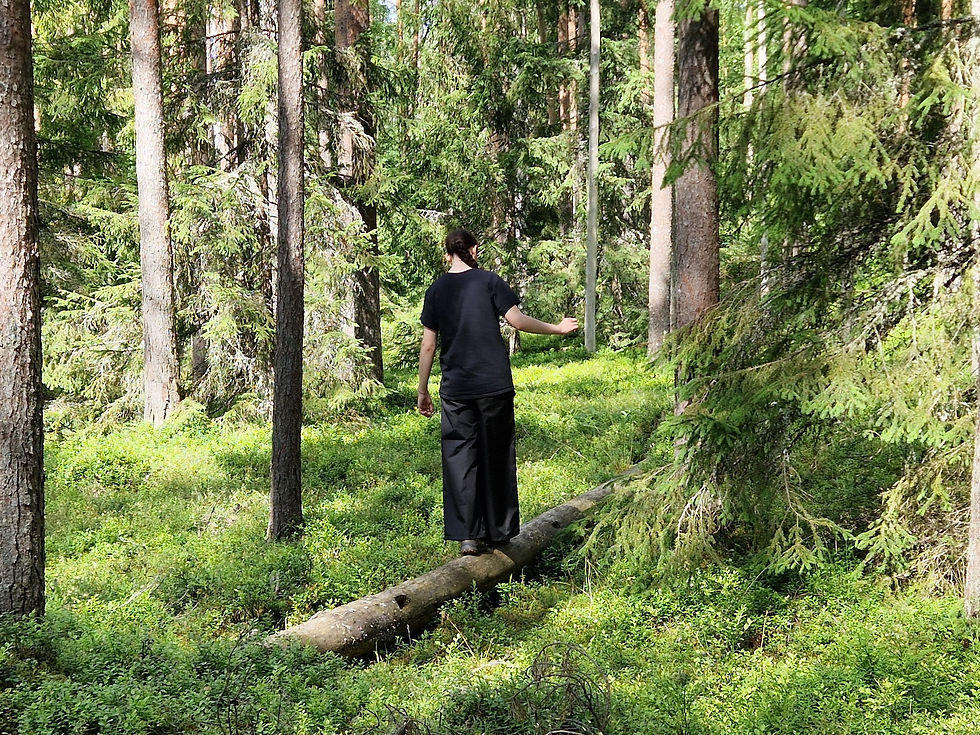
Aim: Gain an overview of adventure therapy, both theoretically and through practical experience.
Topics: Who adventure therapy is used with and how. Experiencing different adventure therapy activities.

What can you experience?
Through foraging, we get to know plants through our senses as well as through new knowledge. We walk through the Pillapalu forest, meadow and garden, encountering plants that are more or less familiar to us. We learn which plants can be used for food, healing and other purposes.
An important part is also the knowledge, experiences and intuition each of us brings and can share with the group. Together, we gather plants to prepare a wild lunch. Foraging becomes a personal practice once again — an opportunity to slow down and discover the gifts and value of the plants we gather.
This time, we prepare lunch together over a fire, using plants found in nature.

Aim: Experience the impact of different exercises and learn how to facilitate them yourself.
Topics: Dilemmas when working in nature. Preparing and facilitating an activity. Self-reflection as a participant and facilitator. Creating your own exercise.

Aim: Learn through your own practical experience and the experiences of others.
Topics: Experiencing a new season in nature. Sharing your personal experience with the group.

what participants
have said
“Through nature, I learned more about myself. Now I know what I can offer my clients.”
“Such an inspiring and much-needed programme for our society. A great small group!”
“Every exercise can be applied in practice and is now part of my toolkit.”
“It was training for myself, combined with rest and wonderful company. I grew as a person, it was life-changing, and nature took on a whole new meaning for me.”
“I dare say this was the most enjoyable training I have ever attended!”

Kristi Raava, Psychologist, trainer and creator of the programme
After working as a school psychologist for 15 years, Kristi completed forest therapy training in Finland in 2019. In recent years, nature has become her main working environment, where she facilitates individual and group therapy sessions and personal development programmes.
Since 2006, Kristi has worked as a communication trainer and is also a values development consultant and trainer at the University of Tartu Ethics Centre. She founded the Estonian Centre for Nature and Animal Therapy, which today continues in a new form as the Kontakt Loodusega lifestyle studio.
“While working as a school psychologist, I eventually outgrew my office and chose nature — with all its space and richness — as my new office.”

Annika Klemets, psychologist
Annika has worked as a psychologist with children, young people and families in both individual and group sessions, and also provides psychological counselling in natural environments. She is connected with the Vodja Individual Learning Centre of Rocca al Mare School, VAU NGO, the rehabilitation centre of Järvamaa Hospital and the Estonian Centre for Nature and Animal Therapy.
Annika graduated from Tallinn University with degrees in psychology and social pedagogy and completed the practitioner development programme “Animals in Learning and Therapy Processes” at the Estonian Centre for Nature and Animal Therapy.

Ella Kari, occupational therapist
Ella graduated in occupational therapy in 2020 and has been interested since the beginning of her studies in the connection between human health and nature, and in how to bring this connection more consciously into professional practice and everyday life. Driven by this interest, she has visited several horticultural therapy gardens in Scotland and continued her education through horticultural therapy training in Estonia and the Baltic countries.
From 2020 to 2026, Ella ran therapeutic gardening groups during the summer in various community gardens in Tallinn. She has also worked as a consultant in the planning of several healing gardens.
Professionally, she has mainly worked with children experiencing mental health difficulties at Vodja School, where the natural environment, farm animals and creative activities supported the therapeutic goals.
Ella has a particular affinity for (wild) plants and extensive knowledge of them, which is valuable both for supporting physical and emotional well-being and for enriching food and everyday life. Plants hold wisdom and power that is always available to us when we choose to embrace it. Today, plants have become Ella’s main field of work and lifelong learning, which she pursues at her family farm in Pillapalu.
course
trainers

“our relationship with nature begins with experience”
Leave your contact details and we will let you know when the dates for the next personal development programme have been confirmed.